There is a moment every baker remembers.
Not the first time they got a recipe right. The first time they understood why it worked. Why the butter needed to be cold. Why the dough pushed back. Why two minutes too long in the oven was the difference between a crust and a collapse.
That moment doesn’t happen watching a screen. It doesn’t happen reading a recipe twice.
It happens when your hands are in it. We’ve been teaching professional baking classes in Chennai for over nine years. And that shift from following instructions to actually understanding is what we design every class around. Not because it makes a good pitch. Because it’s the honest answer to what actually produces a baker.
“I’ve watched hundreds of baking videos. I feel like I already know a lot. Would a class really add anything?”
This is probably the most common thought people arrive with. And it’s fair.
But there’s a gap between knowing and doing that only shows up when you’re standing at a counter with flour on your hands and something isn’t behaving the way the video said it would. You can watch a chef knead dough thirty times and still not recognise in your own hands, when it’s ready. You can memorise the Maillard reaction and still overbrown a tart shell because you couldn’t read the smell in time.
Baking knowledge that stays in the mind stays abstract. It’s only when the body learns alongside the brain that understanding becomes permanent. That’s not philosophy. That’s just how craft works.
“But surely watching an expert demonstrate is almost as good as doing it yourself?”
Almost is the word that matters here.
When you observe, you catch the outcome. The finished product. The broad technique. What you miss are the micro-decisions, the instinct-driven adjustments a skilled baker makes mid-process without announcing them. The slight change in kneading rhythm when the dough feels off. The extra thirty seconds of folding that saves a mousse from breaking. These aren’t steps in a recipe. They’re responses to feedback. And you only develop that responsiveness by being the one doing it.
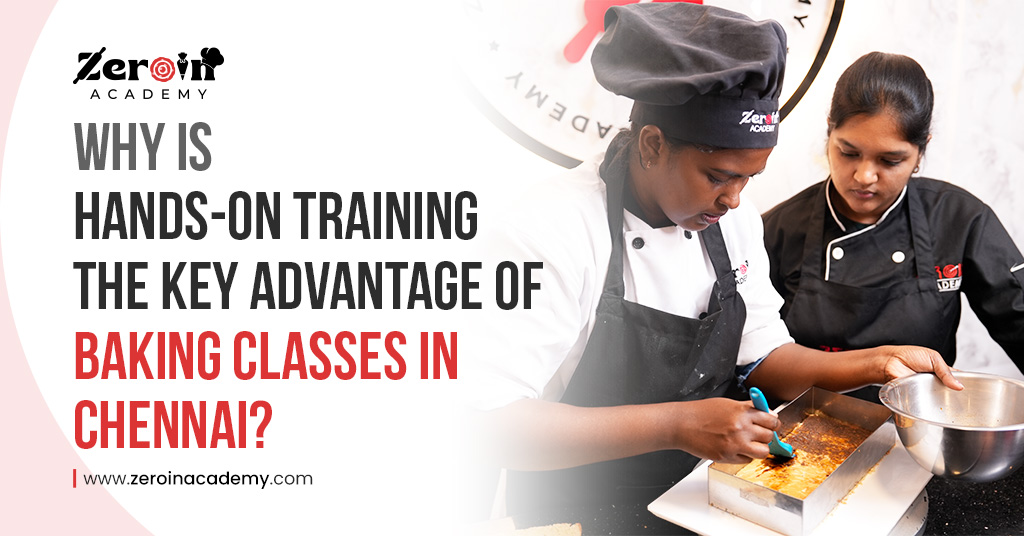
At Zeroin, every student bakes from start to finish in every session. Not after a demonstration. Not as a brief hands-on segment at the end. The entire class is active. Because that’s where the learning actually lives.
“I’m a complete beginner. I worry that hands-on from day one might be overwhelming.”
That concern makes sense. And it’s exactly why structure matters as much as the hands-on approach itself.
Our 4-Day Beginner Baking Class starts where a beginner actually is muffins, cookies, brownies and builds deliberately. Our Diploma in Bakery and Patisserie Arts runs six months with an internationally recognised LAPT certification, and it’s built so a beginner can enter and a professional can emerge. What makes that possible is immediate correction. A trainer who notices what your hands are doing and adjusts it in that moment, not at the end of class, not in written feedback later. That responsiveness is what transforms confusion into confidence, session by session.
“How different can baking academies really be? Isn’t a baking class just a baking class?”
This is where the honest answer gets specific.
The structure of how you learn shapes what you actually take away. A class where you watch and occasionally assist is a different experience from one where you execute every step yourself. The gap becomes obvious when you’re baking alone at home and something goes wrong. One type of training leaves you searching for answers. The other has already put those answers in your hands.
Here’s what that difference looks like in practice:
Here’s what that difference looks like in practice:
| Learning Experience | Zeroin Academy | Demo-Based Baking Classes |
|---|---|---|
| Who does the baking? | Every student, every session, start to finish | Primarily the trainer; students assist or observe |
| When mistakes are corrected | In the moment, by the trainer watching you | After class, or not addressed individually |
| What you take home | A technique your hands remember | A recipe your notes might remember |
| Kitchen environment | Industry-standard, fully equipped, your own station | Shared viewing space, limited individual access |
| Certification | International — LAPT, London | Typically in-house or unrecognised externally |
| Support beyond class | Placement assistance, internship access for diploma students | Rarely structured post-course support |
| Batch size | Small and intentional | Often large, less individual attention |
The difference isn’t in what’s taught. It’s in whether you’ve actually done it.
“I’m not pursuing a career. I just want to bake better at home. Does the depth of training still matter for me?”
Possibly even more.
A professional baker has a team. A home baker has only themselves and usually an occasion that can’t be rescheduled. The confidence to troubleshoot at 10pm before a birthday the next morning, to adapt when something breaks or doesn’t set, that only comes from having made those mistakes already, somewhere safe, with someone who helped you understand what happened and why.
Hands-on training builds self-reliance. And self-reliance is exactly what a home baker needs most.
“Chennai has so many options. Why does the environment you learn in change anything?”
The food culture here is discerning. Customers notice quality, whether it’s a home baker selling on Instagram or a professional in a hotel kitchen. The standard you’re held to is real.
That reality is why the training environment matters. You want your worst mistakes to happen somewhere supported, before they cost you an order or a reputation. Our class in Velachery and Anna Nagar is built to reflect actual bakery conditions, not a home setup scaled up, but an industry environment brought into a learning context. When you train in a space that demands the same precision a real bakery does, the transition out of training is far less jarring.
There’s a student who joined us unable to hold a piping bag steadily. She assumed she didn’t have the hands for it. Eight weeks later, her trainer was photographing her finished work for our gallery.
What changed wasn’t talent. It was repetition. Correction. The specific kind of confidence that only builds when you do something imperfectly, then better, then well with your own hands.
If you’ve been thinking about this, whether you’re a home baker ready to go deeper or someone considering a full career path, and whether you’re in Anna Nagar or looking for Baking Classes in Velachery, come into the kitchen.
I’ve never baked before. Will I be completely lost in a hands-on class?
Not with us. We start from scratch and our trainers are right beside you through every step. Confusion gets corrected in the moment, that’s exactly what hands-on means.
How is baking in our kitchen different from practising at home?
Our kitchen is built to industry standards. You learn on professional equipment, in real conditions. That exposure alone changes how prepared you feel when you bake independently.
I work full-time. Can I realistically fit this in?
Yes. We run both weekday and weekend batches specifically for this reason. You plan around your schedule, we’ll fit around it.
Will I actually remember what I’ve learned after the course ends?
What your hands have done, they don’t forget. We train through repetition and real practice, not just demonstration. That’s the kind of learning that stays.
Is the certificate actually worth anything?
Our diploma students receive internationally recognised certification from LAPT, London. That carries weight with hotels, patisseries and anyone evaluating your credibility professionally.
I just want to start a small home baking business. Do I really need formal training?
Baking for customers is different from baking for family in consistency, quantity and reliability. Our training closes that gap faster than trial and error ever will.
How do I pick the right course without getting it wrong?
Be honest about where you want baking to take you. We offer everything from a 4-day beginner class to a 6-month diploma. If you’re unsure, just reach out—we’ll help you find the right fit, not just the longest programme.