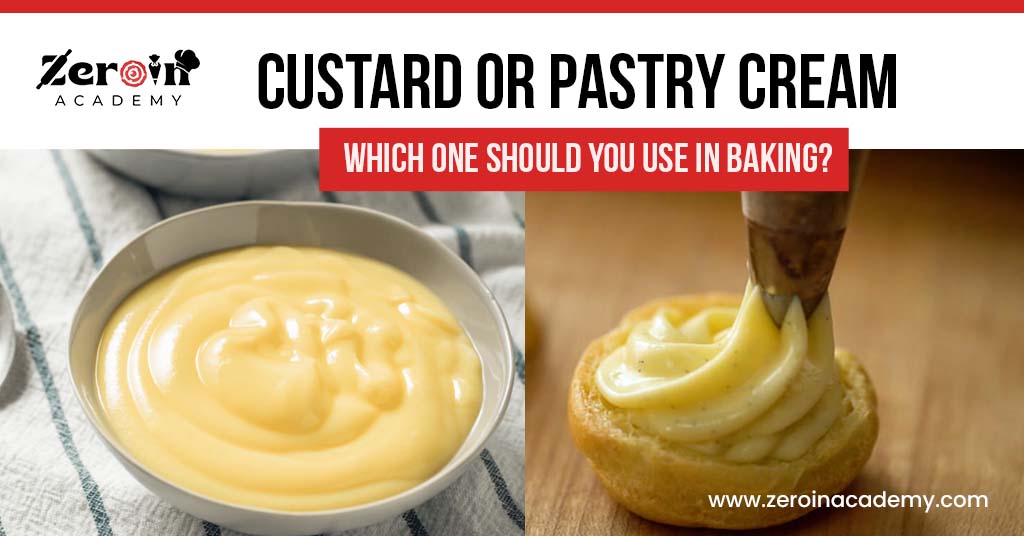
There is a moment in every baker’s journey when a recipe calls for one and instinct reaches for the other. Custard and pastry cream look similar, behave similarly in some contexts, and are often used interchangeably in home kitchens, yet in a professional setting, confusing the two can quietly undermine an otherwise well-executed dessert.
For anyone exploring professional baking classes in Chennai, understanding the difference between these two preparations is one of those foundational lessons that shapes how a baker thinks about texture, application, and intention.
In this blog, we take a closer look at custard and pastry cream what each one is made of, how they differ in texture and stability, where each one belongs in baking, what happens when the wrong one is used, and how a baker develops the judgment to choose correctly. Whether the confusion has come up in a recipe or simply in curiosity, this article works through each distinction with clarity and purpose.
What Exactly Is Custard, and Why Does It Matter in Baking?
Custard is one of the oldest preparations in baking, and its simplicity is part of what makes it so easy to misunderstand.
At its core, custard is a cooked mixture of eggs, milk or cream, and sugar. The eggs act as the thickening agent, when heated gently, the proteins in the yolks coagulate and transform a thin liquid into something silky and set. The result can be pourable, as in a crème anglaise, or firm enough to slice, as in a baked crème caramel.
What defines custard is its delicacy. It does not hold a sharp shape. It does not pipe. It evolves in texture depending on how it is cooked and what it is cooked in. This sensitivity is precisely what makes it beautiful in the right application and unreliable in the wrong one.
What Makes Pastry Cream Different from Custard?
Pastry cream, known in French kitchens as crème pâtissière, begins in the same place as custard eggs, milk, sugar, but takes a different direction almost immediately. The addition of starch, typically cornflour or plain flour, changes everything. Starch stabilises the mixture as it heats, producing a cream that is thick, structured, and firm enough to hold its shape when piped or spread. It builds a body that custard simply does not have.
This is not a subtle difference. Pastry cream can fill an éclair, layer a mille-feuille, or sit inside a tart shell without collapsing. Custard, in the same role, would dissolve the pastry and pool at the base. Understanding this distinction is what separates a dessert that holds together from one that does not.
When Should Custard Be Used Instead of Pastry Cream?
The honest answer is that custard belongs where flow and softness are part of the experience.
Poured warm over a pudding, churned into an ice cream base, baked slowly into a tart that is meant to be trembling and just-set, these are custard’s natural territories. Its lack of structural firmness is not a flaw in these contexts. It is the point.
Replacing custard with pastry cream in a crème brûlée, for instance, would produce something stiff and starchy rather than the barely-there, glass-topped cream the dessert is meant to be. The wrong choice does not just affect taste. It changes the entire character of the dish.
Where Does Pastry Cream Belong, and Why Is It So Widely Used?
Pastry cream is the workhorse of the patisserie kitchen, and with good reason.
Its stability makes it dependable. It can be made ahead, refrigerated, and piped the following day without losing its structure. It fills profiteroles, lines fruit tarts, layers cakes, and forms the base for other creams fold in whipped cream and it becomes diplomat cream, beat in butter and it becomes mousseline. It is a foundation that other preparations are built upon.
This versatility is why pastry cream appears so consistently across classical and contemporary baking. It does not just fill a space, it holds everything around it together.
What Goes Wrong When the Two Are Confused?
Most baking mistakes involving custard and pastry cream come down to one misjudgement: assuming that because they taste similar, they will behave similarly.
A tart filled with custard instead of pastry cream may look perfect coming out of the oven and completely lose its form by the time it reaches the table. A warm pudding served with pastry cream instead of custard will feel heavy and starchy where it should feel light and flowing. Texture in baking is not decoration. It is structure, experience, and intention and getting it right requires understanding what each preparation is actually designed to do.
How Does a Baker Develop the Judgment to Choose Correctly?
This is where knowledge evolves into instinct.
Reading a recipe carefully helps. Understanding the role of starch as a stabiliser helps more. But the most reliable way to build this judgment is through repeated, deliberate practice making both preparations, comparing their textures side by side, and working with them in different applications until the right choice becomes intuitive rather than calculated.
This kind of practical clarity is what structured learning environments are designed to provide. At Zeroin Academy, this understanding is built through hands-on application, not just theory, but the experience of working with both preparations until the difference becomes second nature.
Knowing the Difference Changes How You Bake
That moment of reaching for the wrong preparation, it happens to most bakers at some point. It is not a failure of skill. It is simply a gap in understanding that has not yet been filled.
Once the distinction between custard and pastry cream is genuinely understood, it does not just solve a single recipe problem. It reshapes how a baker reads every recipe that follows, how they assess a dessert’s structure before it is even made, and how confidently they make decisions in the kitchen.
Baking, at its best, is a series of informed choices. And every informed choice begins with understanding what each ingredient and each preparation is truly capable of.
For those looking to build that kind of grounded, practical knowledge, baking classes in Anna Nagar at Zeroin Academy offer a learning environment where preparations like custard and pastry cream are not just discussed, they are understood through the hands, one application at a time.
What is the main difference between custard and pastry cream?
The main difference is the thickening method. Custard relies mainly on eggs, creating a soft, silky, and fluid texture, while pastry cream uses starch to create a thicker consistency that can be piped, spread, and used for structured desserts.
Can pastry cream be used as a substitute for custard in all recipes?
No, they are not always interchangeable. Custard works best for recipes that need a smooth and flowing texture, while pastry cream is designed for fillings and desserts that require more structure. Choosing the right preparation depends on the final result you want.
Why does my pastry cream turn lumpy?
Lumpy pastry cream usually happens when the heating process is too fast or the mixture is not whisked consistently. Properly tempering the eggs, adding hot milk slowly, and continuous whisking during cooking helps create a smooth and creamy texture.
How long can pastry cream be stored?
Pastry cream can be stored in the refrigerator for up to three days. Cover the surface directly with cling film before storing to prevent a skin from forming and to maintain the original texture.
Can custard be made thicker for use in tarts?
Yes, but adding starch changes the preparation into something closer to pastry cream. For tart fillings, it is better to follow a proper pastry cream recipe from the beginning to achieve a stable and reliable texture.
What is diplomat cream, and how is it different from pastry cream?
Diplomat cream is a lighter version made by combining pastry cream with whipped cream. It creates a softer, airier filling that still holds its shape, making it ideal for layered desserts, choux pastry, and delicate sweet creations.