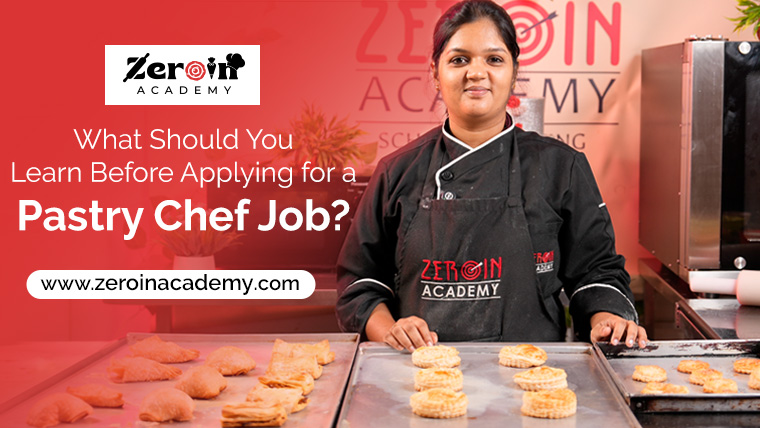
Most rejected pastry chef candidates fail for the same reason: they can bake well at home but cannot execute under commercial kitchen pressure. A five-star hotel kitchen expects a candidate to laminate croissant dough within a set time window, temper chocolate to an exact working range, and plate forty identical desserts for a banquet without variation. Baking Classes in Anna Nagar prepare candidates for precisely this gap between hobbyist skill and professional execution. This article covers the specific techniques hiring chefs test during trial shifts, the food safety certifications kitchens require before onboarding, the portfolio elements that get candidates shortlisted, and the interpersonal habits that determine whether a probation period converts into a permanent role. Read on for the exact preparation checklist a candidate needs before walking into an interview.
Why Home Baking Skill Does Not Transfer Automatically
A home baker measures flour by feel and adjusts oven time by watching color. A commercial kitchen runs on gram-accurate scaling, standardized batch sizes, and recipes written for output volumes of fifty portions or more. Executive chefs interviewing candidates routinely ask them to scale a recipe from four servings to forty on the spot. Candidates without formal training hesitate on this task because they never practiced ratio-based scaling. Structured culinary training closes this exact gap by drilling candidates on commercial-scale production before they face a real kitchen floor.
Technical Skills Hiring Chefs Test During Trial Shifts
Interview panels for pastry chef roles rarely rely on resumes alone. Most conduct a practical trial where candidates demonstrate the following:
- Lamination technique: Rolling and folding butter into croissant or puff pastry dough within a temperature window of 15-18°C, since warmer dough causes butter to leak and ruins the layers.
- Chocolate tempering: Bringing dark chocolate through the seeding method to a working range of 31-32°C, verified with a temperature probe rather than guesswork.
- Choux pastry execution: Piping éclairs or profiteroles that come out the same size across a full tray, then hold their shape and puff evenly instead of collapsing once they cool.
- Sugar work: Working sugar at the hard-crack stage, around 150°C, without it seizing into a grainy mess or burning fingers in the process.
- Cake assembly under time pressure: Building a tiered cake with a stable crumb coat within a set window, typically 30-45 minutes for a two-tier order.
Candidates who walk into a trial shift already comfortable with these benchmarks stand out immediately against those seeing commercial-scale production for the first time.
Ingredient Science Employers Expect Candidates to Explain
A pastry chef candidate should be able to explain, without hesitation, why a soufflé collapses or why a cake sinks in the center. Gluten development from overmixing, insufficient leavening from expired baking powder, and premature oven door opening account for most textural failures. Interviewers frequently ask candidates to diagnose a failed bake from a photograph. A candidate who can name the cause and fix it on the spot shows real technical grounding, not just memorized recipe steps. This diagnostic ability also matters for allergen adaptation, since substituting almond flour for wheat flour changes moisture absorption and requires recalculated liquid ratios.
Food Safety Certification Requirements Before Applying
Indian hospitality employers require FSSAI food safety certification as a baseline before extending an offer letter, and most five-star properties add an internal HACCP orientation during onboarding. Pastry sections handle high-risk ingredients, including raw egg-based mousses, dairy fillings, and cream, all of which spoil quickly outside a 4°C storage range. If a candidate can’t name the temperature danger zone for bacteria, roughly 5°C to 60°C, that’s usually enough for an interviewer to flag concern on the spot. Most kitchens test this with a few pointed questions rather than taking a resume’s word for it.
Portfolio Elements That Get Candidates Shortlisted
Most recruiters give a pastry chef portfolio less than two minutes before deciding whether to call the candidate in for a trial. What makes them stop scrolling:
- Natural-light photos that show a cross-section of the cake or pastry, not just a polished top view
- Recipes written in grams, not vague cup measurements that mean something different in every kitchen
- Proof of at least one time you scaled a recipe up for a big order or event
- A real reference, name and phone number included, from an instructor or head chef who will actually pick up the call
- Copies of certificates from recognized training programs, food safety included
Submit generic, stock-style shots with no process behind them, and most recruiters will not even get to the interview stage.
Interpersonal Skills That Determine Probation Outcomes
Technical skill gets a candidate through the trial shift. Probation survival depends on different factors entirely. A pastry section works in constant coordination with the kitchen’s savory side and the front-of-house team, particularly around allergen disclosure for dessert menus. A chef who cannot calmly communicate a substitution mid-service, or who reacts defensively to a head chef’s correction, typically does not survive a ninety-day probation period regardless of technical talent. Kitchens report time management as the second most common reason for probation failure, since a pastry section that falls behind delays plating for the entire dining room.
How Structured Training Shortens the Gap to Job Readiness
A candidate without formal training typically needs six to twelve months of on-the-job correction before reaching baseline competency, and much of that learning happens through costly mistakes on a working kitchen floor. Structured programs compress this timeline by simulating commercial conditions during training itself, including timed practicals and ingredient-cost accountability. Candidates who train under this format arrive at their first job already accustomed to scrutiny, correction, and repetition, which shortens the adjustment period employers otherwise build into a new hire’s first few months.
Building Job-Ready Skills with Zero In Academy
At Zero In Academy, students train on the same things hiring chefs actually test in a trial shift: scaling recipes accurately, tempering chocolate under a clock, holding shape under pressure. Our Baking Class Coimbatore batches run on commercial equipment in real working-kitchen conditions, not a home kitchen setup, so students walk into their first interview already used to the pressure.
Do I need a culinary degree to apply for a pastry chef job?
Not always. What matters more is FSSAI certification and being able to prove your technical training in a hands-on trial, degree or no degree.
How long does it take to become job-ready as a pastry chef?
If you’ve already spent time in a kitchen, four to six months of structured training usually gets you to entry-level ready. Starting from zero takes closer to eight to twelve months of steady practice.
What certifications matter most for pastry chef roles?
FSSAI food safety certification is not optional at any hospitality employer in India. Beyond that, credentials in chocolate work or advanced cake decoration help you stand out for the roles that pay better.
Should I specialize early, or learn broadly first?
For an entry-level role, you need to be solid across lamination, chocolate work, sugar craft, and cake assembly, not just good at one of them.
Does portfolio quality matter more than baking skill during hiring?
Portfolio quality determines whether a candidate gets called for a trial shift. Baking skill determines whether that trial converts into a job offer. Both stages matter, but they filter candidates at different points.