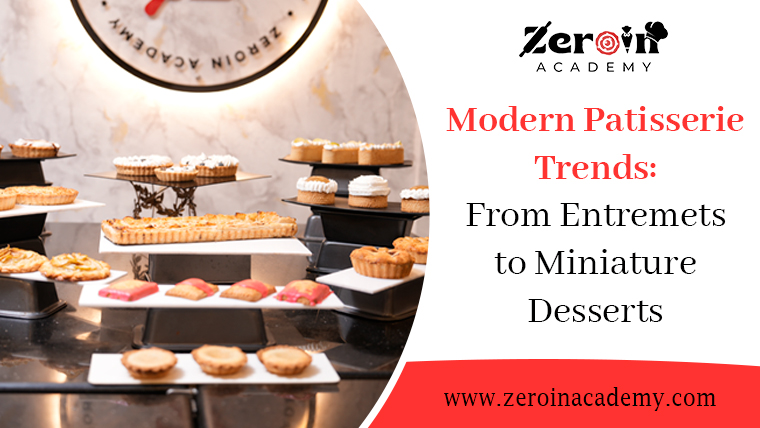
Modern patisserie has moved from single-flavor cakes to desserts built from several textures, and from large formats to individual portions. Entremets lead that shift by combining a crisp base, a soft insert, and an aerated mousse under a glaze. Miniature desserts apply the same structure at a size that suits boxed orders, events, and café counters. Flavor direction now favors fruit acidity, lower sweetness, and regional ingredients such as cardamom, coconut, and filter coffee. Chennai’s summer heat and year-round humidity change how gelatin sets, how long an entremets needs in the freezer, and how a finished dessert holds up in storage and delivery. Bakers who control these variables produce consistent results and price their work accurately. Zero In Academy teaches each of these skills through supervised practice in its Baking Courses in Chennai. The sections below explain how entremets are built, why miniature desserts sell, and which skills a student needs.
What Defines Modern Patisserie
Classic patisserie centered on one dominant flavor and a sponge. Current work builds each dessert from three to five components, and every component has a defined role. A crunchy layer provides contrast. A fruit or caramel insert adds acidity or depth. The mousse carries the main flavor, and the glaze or spray finish completes the surface.
Customers now judge a dessert by its cross-section. A bakery that sells a uniform soft cake competes poorly against one that serves a clean, layered cut.
Entremets: Structure and Components
An entremets is a molded, layered dessert that is frozen, unmolded, and finished. Most entremets use the same four components, prepared in an order that gives the insert and base time to set before the mousse goes in:
- Insert: A crémeux, compote, or fruit jelly poured into a smaller mold and frozen solid. Prepare it first, since it needs a full night to firm up.
- Base: A dacquoise, sablé, or thin biscuit cut 5 to 8 mm thick and baked while the insert freezes.
- Mousse: A cream or custard base stabilized with gelatin and lightened with whipped cream.
- Finish: A mirror glaze, velvet spray, or thin coating with decoration.
The insert causes the most failures among beginners. If it is not frozen solid before assembly, it sinks, shifts off-center, and shows unevenly at the cut edge. Students who freeze inserts overnight and use an insert mold slightly smaller than the entremets ring correct most of these faults early.
Techniques That Decide the Result
Small errors in temperature and weight show up at the unmolding stage, when they can no longer be corrected. Our trainers focus on five controls:
- Gelatin accuracy: Weigh gelatin by bloom strength and batch mass. Too much produces a rubbery bite, and too little collapses on unmolding.
- Mousse temperature: Fold whipped cream into a base cooled to about 30°C. A warmer base deflates the cream, while a cooler one sets in lumps.
- Freezing: Freeze the assembled entremets at -18°C or lower until fully solid before glazing.
- Glaze temperature: Pour mirror glaze between 32°C and 35°C. Hotter glaze runs thin and slides off, and cooler glaze leaves an uneven, thick coat.
- Finishing: Remove excess glaze from the base before it sets around the edge.
Miniature Desserts: Why Smaller Formats Sell
Miniature desserts keep the layered structure of an entremets in a single portion of roughly 40 to 90 grams. Common formats include individual entremets, tartlets, verrines, and choux bites.
Demand comes from how people order. Wedding hosts, corporate teams, and festive gift buyers want assorted boxes that let guests taste several flavors. Bakeries benefit as well, because unsold portions are sold by the piece and fewer slices are wasted.
Production is not simpler. Each piece requires a mold cavity, a measured insert, and a glaze, so labor per gram rises as size falls.
| Factor | Full-size entremets | Miniature dessert |
|---|---|---|
| Portion | 6 to 10 servings | One serving, about 40 to 90 g |
| Typical use | Celebrations and gifting | Dessert boxes, events, cafe counters |
| Production method |
One mold, one glaze | Multi-cavity molds, batch glazing |
| Labor per gram | Lower | Higher |
| Waste risk | Higher once sliced | Lower, sold by unit |
Flavor and Texture Directions
Fruit-forward inserts now balance sweeter mousses. Passion fruit, mango, and lemon offset white chocolate or caramel, and the result tastes lighter without removing sugar from the structure. Some bakers also reduce sugar in the mousse itself and rely on a tart insert for contrast.
Regional ingredients are entering professional menus. Cardamom crémeux, filter coffee mousse, jaggery caramel, coconut dacquoise, and rose with lychee all appear in current dessert boxes. Each one needs adjustment, since jaggery adds moisture and coconut changes the structure of a dacquoise.
Texture work has become more deliberate. A praline feuilletine layer or a toasted nut crumble gives a mousse-based dessert a crisp point in every bite.
Heat and Humidity in Chennai Kitchens
Summer temperatures in Chennai often exceed 35°C, and humidity stays high for most of the year. Whipped cream loses stability quickly under those conditions. Glazed desserts form condensation when moved from the freezer to a warm room, and sugar decorations soften within minutes.
Bakers manage this with chilled bowls, smaller batches, and a blast chiller or a freezer set to its lowest stable temperature. Finished pieces go into airtight containers, and deliveries travel in insulated boxes with cold packs. These steps cost little and prevent most of the returns that small bakeries report during summer.
Skills a Patisserie Student Needs
Students also need to scale, cost, and hold products. Our patisserie training covers:
- Scaling a recipe from one entremets to a tray of miniature desserts
- Costing each component by weight, including mold and labor time
- Piping, molding, and glazing with consistent portions
- Holding finished pieces at safe temperatures during storage and delivery
- Labeling and food safety requirements under FSSAI rules
A student who completes these exercises can quote an event order accurately and deliver it without remaking pieces.