There is a moment most bakers know deeply. You follow the recipe exactly. You measure everything right. You do not skip a step. And yet, what comes out of the oven is either too pale, too dense, or somehow wrong in a way you cannot fully explain. You stand there staring at it, wondering what went wrong. It is a quiet, deflating feeling , one that makes you question whether baking is something you can actually get better at, or whether some people are simply born with the instinct and others are not.
We hear this from students who walk into our Baking Courses in Chennai regularly. And almost every time, when we trace the problem back to its source, temperature is the answer. Not ingredients. Not effort. Temperature.
It is the variable that most recipes mention but rarely explain. And it is the one thing that, once you truly understand it, changes how you approach every single bake.
Why Temperature Is Not Just a Number on a Dial
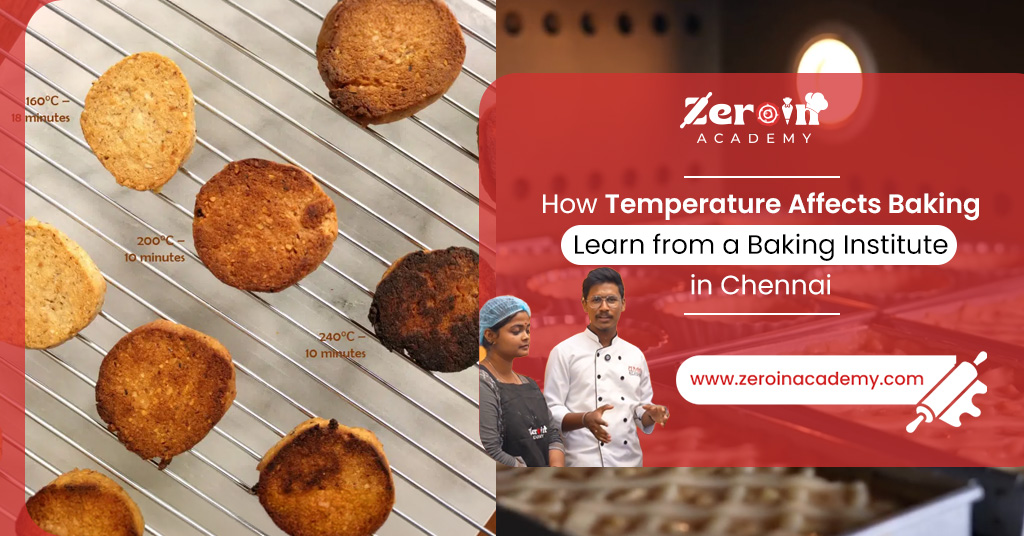
When a recipe says “preheat to 180°C,” most people treat that as a formality. Set it and forget it. But your oven’s internal temperature, the temperature of your ingredients, the ambient temperature of your kitchen, all of these are active forces that shape what happens inside your batter or dough. Temperature does not just cook food. It controls structure, texture, rise, colour, and flavour. It decides whether your croissant has flaky layers or a dense, bready centre. It determines whether your sponge is light or gummy. Every degree matters more than most people realise.
Cold Butter, Warm Butter, It Is Not the Same Thing
One of the first lessons we revisit in our sessions here at Zeroin Academy, our baking institute in Chennai, is the state of butter. Cold butter, when cut into flour, creates pockets of fat that steam during baking that is what gives pastry its flakiness. Room temperature butter, when creamed with sugar, traps air and that air is what makes a cake rise and feel tender. Melted butter creates density and moisture. Same ingredient, three completely different results. The temperature of butter before it even touches the mixing bowl is already shaping the outcome.
This is not a small detail. It is a foundational truth.
Your Oven Lies to You and That Is Not an Exaggeration
Most home ovens are inaccurate. The dial says 180°C. The actual temperature inside might be 165°C or 200°C. Hot spots exist near the back, near the top, near the heating element. Professional bakers know this. They use oven thermometers. They rotate their trays. They learn their specific oven the way a musician learns an instrument with patience, attention, and a willingness to adjust.
Understanding your oven is not about distrust. It is about building a working relationship with your equipment. And that relationship evolves the more you bake intentionally rather than instinctively.
The Temperature of Ingredients Before They Meet Each Other
Here is something that surprises many new bakers. When cold eggs are added to a batter made with room temperature butter, the mixture can split or curdle. The fat seizes up from the temperature shock. This is not a technique failure. It is a temperature failure. Ingredients that are asked to come together need to be at compatible temperatures. Warm eggs emulsify better. Room temperature dairy blends more smoothly. These are not fussy preferences, they are the conditions that allow your ingredients to cooperate.
Taking thirty minutes to bring your eggs to room temperature before baking shapes the final texture of your cake more than almost any other single action.
Proofing, Fermentation, and the Living Science of Bread
Bread dough is alive. Yeast is a living organism, and it responds directly to heat. Too cold, and fermentation slows to a near halt, your dough will not rise adequately. Too warm, and the yeast overworks, producing an unpleasant, overly sour flavour before the gluten has time to develop properly. The sweet spot, that warm, slightly humid environment between 25°C and 28°C is where bread dough does its best work.
In Chennai’s tropical climate, this is both an advantage and a challenge. The warmth supports fermentation naturally. But in peak summer, kitchens can become too hot, and dough can overproof faster than expected. Learning to read your dough, not just follow a timer, is a skill that builds with practice and awareness.
Sugar Behaves Differently at Every Stage of Heat
Sugar is perhaps the most temperature-sensitive ingredient in a baker’s pantry. At different temperatures, it becomes syrup, soft ball, firm ball, hard crack, or caramel. Each stage has a name, a purpose, and a precise temperature range. Fudge, toffee, nougat, spun sugar, these are not just different recipes. They are different temperature destinations. A candy thermometer is not optional equipment when working with sugar. It is a necessity. And understanding what sugar does at 115°C versus 145°C is what separates a confident confectioner from someone who keeps producing the wrong result without knowing why.
What Structured Learning Does That Trial and Error Cannot
You can learn some of this through repetition at home. But there is a limit to how far trial and error can take you when you do not know which variable to isolate. This is where structured learning builds something different, it gives you a framework. At Zeroin Academy, our baking institute in Chennai, we teach temperature not as a side note but as a central pillar of baking science.Students stop just following steps and start actually understanding what is happening inside the bowl and the oven. That one shift, from copying to comprehending is what gives them the confidence to fix a mistake mid-bake, adjust a recipe without panic, and eventually trust their own judgment in the kitchen.
Our 6 Months International Diploma in Baking and Patisserie covers these principles in depth from the science of ingredient interaction to the practical realities of professional kitchen environments. It is designed for those who want to understand baking, not just perform it.
Circling Back to That Quiet Moment
Remember that feeling, standing in front of something that did not turn out the way it should have? That moment does not have to be the end of confidence. It can be the beginning of curiosity. Once you understand that temperature was likely the silent culprit, something shifts. You stop blaming your hands and start asking better questions.
That is what real learning does. It transforms frustration into inquiry.
If you are based in Chennai and looking for a place where baking is taught with this kind of depth and honesty, we would love to have you with us. Whether you join us in Velachery or through our baking classes in Anna Nagar, you will find a space where questions are welcome, the science is explained clearly, and every batch, even the imperfect ones becomes a lesson worth having.
Baking is not about perfection. It is about understanding. And understanding, once it arrives, stays with you.