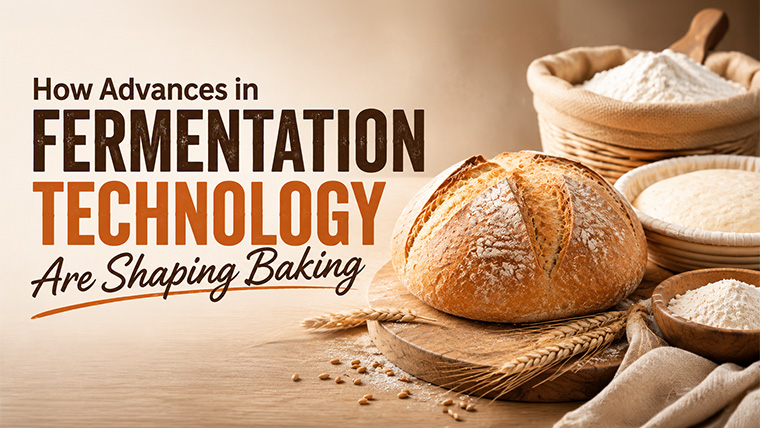
Bread has risen the same basic way for thousands of years: flour, water, yeast, and time. That chemistry hasn’t changed. What has changed is how much control bakers now have over it. Sensors track a starter’s every bubble, and AI models predict proof times to the minute. Bakeries that once relied on a baker’s nose now pair that instinct with real data. Our baking classes in Chennai cover both the traditional technique and the technology now built around it.
What Fermentation Actually Does
Fermentation starts when yeast and bacteria get into the sugars and starches in flour. That’s what gives off the carbon dioxide that makes dough rise. That gas gets trapped in the dough’s gluten network, and that’s what makes bread rise. The same process builds flavor. Organic acids and alcohols form along the way, giving sourdough its tang and artisan loaves their depth.
Fermentation shows up well beyond bread, in chocolate, vinegar, cheese, vitamins, and antibiotics.
The Stages of Bread Fermentation
A loaf typically passes through five stages before it reaches the oven:
Preferment. Flour, water, and a small amount of yeast rest together for hours, sometimes a full day. This step builds the deep flavor found in artisan breads and helps the finished loaf stay fresh longer.
Bulk fermentation. The preferment gets mixed into the rest of the dough. Depending on the bread, this stage can run up to eight hours.
Second fermentation. After the dough is punched down, it rests again, developing more structure.
Proofing. Once the loaf is shaped, it proofs anywhere from an hour to a full day before baking.
Baking. Heat drives one last burst of yeast activity, then steam and oven spring finish the job, giving the loaf its final rise and crust.
Where the Technology Comes In
For most of baking history, judging fermentation meant poking the dough and hoping. That’s shifting fast.
AI-guided sourdough monitoring. Researchers at Cardiff University, Shanxi University, and Jiangnan University recently published a review on pairing artificial intelligence with microbial analysis to make sourdough fermentation more predictable at commercial scale. Large bakeries have long struggled with slow fermentation windows and results that shift when temperature or humidity drifts. AI models trained on sensor data can now flag those changes before they affect a batch.
Smart sensors for home and commercial use. Devices like the Crustello sourdough kit use lid-mounted sensors to track dough height, temperature, and humidity, feeding the data into an app that predicts when a starter is ready. Barilla has piloted similar neural network models on its production lines to monitor fermentation and control proofing across large batches, chasing the same consistency a skilled baker once managed by feel alone.
Gas sensor arrays. Food scientists have also built low-cost systems that read the gases coming off fermenting sourdough to estimate pH and acidity, without sampling or disturbing the dough.
Gluten-free and alternative flours. Fermentation is helping solve one of gluten-free baking’s oldest problems: texture. Longer, more controlled fermentation improves the rise and crumb structure of doughs made without wheat, while also unlocking ancient grains and less common flours for everyday baking.
Precision fermentation for ingredients. Beyond the loaf itself, precision fermentation now produces proteins, colorants, and other food ingredients by engineering microbes to manufacture them directly. It’s a young field still working through scale and cost, but it points to where flavor and nutrition science may head next.
What This Means for Bakers
None of this replaces skill. A baker still needs to understand what a dough is telling them. But sensors and models remove some of the guesswork, especially for bakeries producing hundreds of loaves a day where a two-degree temperature swing can throw off an entire batch. For home bakers, the same technology means fewer ruined starters and a shorter learning curve.
At our baking classes in Chennai Velachery, we teach the fundamentals first: how to read a dough, how temperature and time interact, and why a sourdough starter behaves differently in July than in January. Once you understand that, the tools make a lot more sense, and you’ll know when to trust the data and when to trust your hands.
How long does bread fermentation usually take?
It depends on the bread. A quick yeasted loaf might proof in under two hours, while an artisan sourdough can spend eight hours or more in bulk fermentation, plus additional time proofing after shaping.
Can I speed up fermentation without ruining the flavor?
Warmer temperatures speed things up, but pushing too hard usually costs you flavor and structure. A slower, cooler fermentation builds more complex taste. If you’re short on time, a small increase in yeast quantity works better than cranking up the heat.
Do I need a smart sensor to bake good sourdough at home?
No. Bakers managed fine for centuries without one. A sensor just takes some of the guesswork out of judging when a starter or dough is ready, which helps if you’re new to sourdough or baking in an unpredictable kitchen.
What’s the difference between fermentation and proofing?
Proofing is really just the last stretch of fermentation. Once the loaf is shaped, it gets one final rest before the oven, and that’s what most people mean when they say “proofing.” Fermentation is the whole process, from the first mix to that last rise.
Is precision fermentation something home bakers will see soon?
Not directly. It’s currently used to manufacture ingredients like proteins and colorants at an industrial level, not to bake bread at home. That said, ingredients made this way could eventually show up in products on store shelves.
Fermentation has always been part science, part patience. The tools around it keep improving, but the dough still sets the pace. Learn to read it well, and every loaf gets a little more predictable, no matter how much technology sits on the counter beside it.