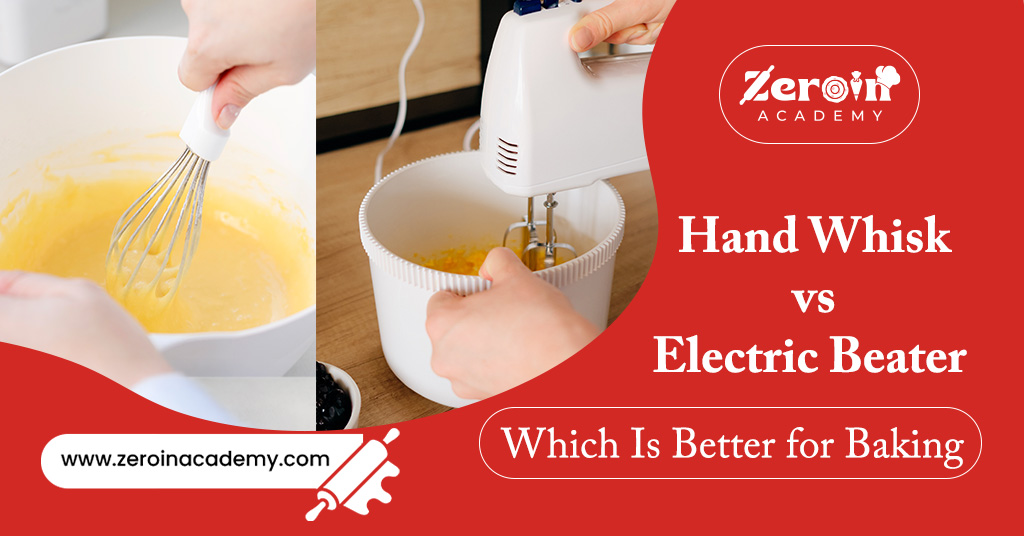
There is a moment every baker remembers. You are standing in your kitchen, bowl in front of you, arm already tired, and you wonder if you are doing this the hard way for no reason. Whether you just signed up for Professional Baking Classes In Chennai or you have been baking quietly at home for years, this feeling finds everyone. The batter is not quite coming together. Your wrist aches. And somewhere in the back of your mind, you are questioning every choice that led you to this point including the one where you decided to do it by hand.
We have seen this moment in our students more times than we can count. That quiet frustration that lives right between enthusiasm and skill. It is not a failure. It is actually the beginning of real understanding.
At Zero In Academy, we believe baking is not about shortcuts or complexity. It is about knowing why you are making each choice and then making it with intention. So when students ask us whether to use a hand whisk or an electric beater, we never give them a quick answer. Because the honest answer is layered.
Let us walk through it together.
Is It Better to Beat or Whisk in Baking?
This question is really two questions hiding inside one. Beating and whisking are not the same motion, and they do not serve the same purpose.
Whisking is gentle and aerating. It builds lightness. When you whisk egg whites or fold a delicate sponge batter, you are coaxing air into the mixture and that air is what gives your cake its lift. Too much force and you collapse what you just created.
Beating, on the other hand, is deliberate and vigorous. It develops structure. When you beat butter and sugar together, you are not just mixing you are creating tiny air pockets that shape how your baked good rises and browns.
Understanding the difference between these two actions evolves the way you approach every recipe. It is not about which tool you pick first. It is about what the batter actually needs from you in that moment.
Which Is the Best Mixer for Baking?
Here is the honest answer: there is no single best mixer. There is only the right tool for the right task.
A hand whisk gives you control. You feel the resistance of the batter. You can sense when it shifts, when the eggs ribbon, when the cream stiffens, when the roux begins to pull away from the pan. That tactile feedback is irreplaceable in the early stages of learning. It builds intuition.
An electric beater gives you consistency and speed. For tasks like whipping heavy cream to stiff peaks or creaming butter for an extended period, an electric beater handles the labour without compromise. Your output stays reliable even when your energy does not.
The best mixer for baking is the one that matches both the recipe and your current stage as a baker. That answer changes as you grow.
Is a Hand Mixer Better Than an Electric Mixer?
This is where most debates land and where most debates miss the point entirely.
A hand mixer is portable and responsive. You move it through the bowl, adjust angles, and stay in conversation with the mixture. It works beautifully for lighter tasks: whipping cream, beating eggs, mixing muffin batter.
A stand electric mixer brings power and hands-free operation. For bread dough, stiff cookie doughs, or large batches, it does what no human arm sustainably can. Neither is superior. They are different instruments in the same kitchen. The baker who understands both is the one who bakes with real confidence and real results. At Zero In Academy, we teach our students to work with both from day one, because skill without versatility has a ceiling.
Can I Use an Electric Mixer Instead of a Whisk?
Sometimes, yes. But not always and the difference matters more than you might think.
When a recipe calls for gentle folding or a quick hand-whisked emulsification, an electric mixer can over-beat and break the structure you need. Electric power does not always equal better outcome. In fact, over-mixed muffin batter becomes tough. Over-beaten chocolate ganache splits. More speed, in those moments, means more damage.
The skill is not in knowing how to use each tool. The skill is in knowing when not to use one.
This is the kind of nuanced, practical understanding that shapes a real baker the kind we work to build every day inside our International Diploma in Baking and Patisserie programme. It is not just about recipes. It is about developing the judgment to read a batter, trust your instincts, and make thoughtful decisions at every stage of the process.
The Tool Does Not Make the Baker
Remember that moment at the beginning the tired wrist, the stubborn batter, the quiet doubt?
That moment is not a problem to solve with better equipment. It is a question your baking journey is asking you. Do you understand what is happening in this bowl right now?
When you do, the whisk and the beater both become exactly what they are: tools in the hands of someone who knows how to use them.
If you are ready to build that kind of foundation, we would love to have you with us. Explore our baking classes in Velachery and take the first step toward baking with real clarity not just confidence, but understanding.
That is where it all begins.