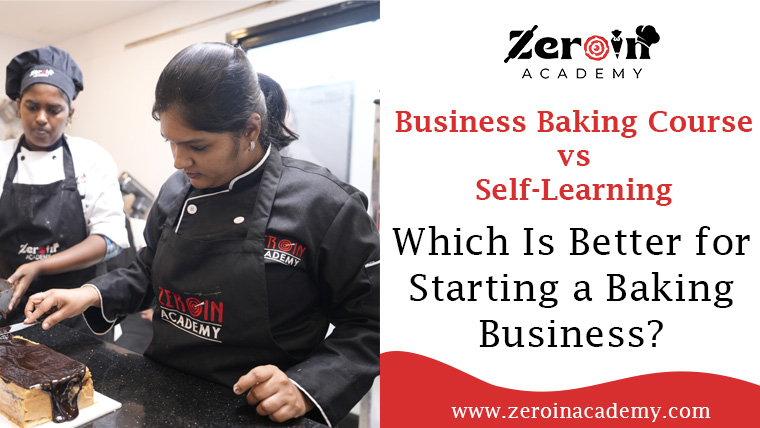
You want to bake for a living. Maybe you already sell custom cakes to friends. Or you just test recipes on weekends, trying to figure out if this could actually pay the bills. Every home baker faces the exact same decision. You either teach yourself through YouTube and trial and error, or you enrol in professional bakery courses in Chennai to learn the business side.
Both paths work. But they do not take the same amount of time. Wasted ingredients and underpriced orders cost money. Figuring out the business side alone takes months. A structured program like Zeroin Academy’s Business Baking Course bypasses that phase entirely. It gives you the fastest route from a weekend hobby to actually getting paying customers.
What self-learning actually teaches you (and what it skips)
Self-learning has real advantages. It costs almost nothing to start, you set your own pace, and there is no shortage of recipes online to practise with. Plenty of home bakers have built a small following this way before ever taking a formal class.
But here is where it usually falls apart:
- You learn recipes, not principles. You can follow a video for chocolate cake, but you may not understand why a different cake collapses when you change the pan size or oven temperature.
- Costing and pricing get guessed, not calculated. Most self-taught bakers underprice their work for months before realising they are barely covering ingredients.
- Food safety, packaging, and shelf life often get skipped entirely until a client complains or an order goes wrong.
- There is no one correcting your technique in real time. A video cannot see that your buttercream is splitting or your dough is over-proofed.
None of this means self-learning fails. It just means the learning curve is longer, and a lot of mistakes are made on an actual customer’s order.
What a structured business baking course gives you that videos cannot
A proper baking course compresses years of trial and error into a matter of weeks. Good programs cover:
- Core baking techniques taught with the reasoning behind them, not just the steps.
- Costing, pricing, and profit margins specific to home bakery businesses.
- Hygiene standards and food safety practices that matter once you are selling to the public.
- Packaging, presentation, and how to photograph your products for social media.
- Direct feedback from trainers who catch mistakes before they become habits.
This is exactly the gap a course like Zeroin Academy’s 4 Weeks Business Baking Course is built to close. Instead of guessing your way through pricing and technique, you get structured, hands-on training with people watching your work and correcting it on the spot.
Time, money, and how fast you can actually start earning
Self-learning looks cheaper on paper, and in terms of direct cost, it usually is. But factor in the wasted ingredients, the orders that go wrong, and the months spent underpricing your work, and the gap narrows quickly.
A structured course asks for a bigger upfront investment, but it also compresses your timeline. Most students walk out with a working understanding of technique, pricing, and presentation in a matter of weeks, not the year or two it can take to piece the same knowledge together alone.
The business side nobody plans for
This is the part that trips up most self-taught bakers. Baking well and running a baking business are two different skills. You need to know your cost per unit, how to price for profit instead of just covering ingredients, how to package for delivery, and how to handle repeat customers professionally.
A course built around starting a business, rather than just teaching recipes, folds all of this in from the start. That is the real difference between learning to bake and learning to run a bakery.
So which one should you choose?
If you are baking purely as a hobby with no plans to sell, self-learning is completely fine. Take your time, enjoy the process, and let YouTube be your teacher.
But if you are serious about turning this into income, even part-time, a structured course saves you months of guesswork. It gives you the technical foundation, the business knowledge, and the confidence to price and sell your work properly from day one.
Final thoughts
There is no single right answer here. It depends on your goals, your timeline, and how much guesswork you are willing to work through on your own. If you would rather skip the trial and error and get direct guidance instead, look into baking classes in Velachery, where hands-on training and business fundamentals are taught side by side, so you are not just learning recipes, you are learning how to actually run a bakery.
Can I start a baking business without any formal training?
You can, and plenty of home bakers do exactly that. What usually happens is the learning still occurs, just later, when a client complains about inconsistent cakes or you realise you have been pricing an order below cost for months.
How long does a business baking course usually take?
Depends where you go. A hobby class might run over a weekend, but something built for people who actually want to sell, like a 4-week format, takes longer because it has to cover pricing, hygiene, and packaging alongside the baking itself.
Is a baking course worth it if I already know how to bake well?
Often yes, since most self-taught bakers are strong on technique but weak on costing, pricing, and business fundamentals, which a good course covers directly.
Do I need a certificate to sell baked goods from home?
A certificate is not usually a legal requirement, but it does build trust with customers and can support your credibility if you plan to grow your business.
What is the biggest mistake self-taught bakers make?
Underpricing. Without knowing your true cost per unit, it is easy to price for survival rather than profit.
Can I combine self-learning with a short course?
Absolutely. Many people build a base through self-practice and then take a focused course to fill in the business gaps.