There’s a particular kind of panic that hits at 6 PM on a Sunday. The cake needs to chill before it can be frosted. The bread needs another hour to proof. And somehow, dinner still needs to happen. Anyone who has baked at home knows this feeling, the sense that time is not on your side, that baking seems to run on its own clock, indifferent to yours. It’s one of the first things that pushes people to look for structured baking courses in Chennai, hoping someone will finally explain why the same recipe takes forty minutes one day and ninety the next.
The truth is, baking doesn’t run on your clock. It runs on chemistry, temperature, and patience. And that single realization is where every professional baker’s relationship with time actually begins.
This blog looks at the time management skills that professional baking courses quietly build into every student, often without the student even noticing. It covers why baking demands a different sense of time than cooking does, how sequencing and mise en place change the way a kitchen moves, why patience is treated as a technical skill rather than a virtue, how multitasking in a bakery looks nothing like multitasking anywhere else, and why professional training environments compress years of trial-and-error into a few focused months. Read together, these ideas explain something that home bakers often sense but rarely articulate: that getting better at baking is, in large part, getting better at managing time itself. From here, it’s worth breaking each of these down individually, starting with the most basic and least understood distinction the difference between cooking time and baking time.
Baking Time Is Not Cooking Time
Cooking is forgiving. Taste as you go, adjust, add a little more salt. Baking rarely offers that kind of flexibility. Once batter goes into the oven, the decisions have already been made. This is why professional courses spend so much time on the “why” behind timing, why a cake needs exactly this long at exactly this temperature, why opening the oven door early can undo twenty minutes of careful work. Students don’t just learn to follow a timer. They learn to understand what the timer represents.
Why Sequencing Comes Before Speed
Ask any culinary instructor what separates a hesitant student from a confident one, and the answer is rarely speed. It’s sequencing. Professional courses train students to think several steps ahead before they’ve measured a single ingredient. What needs to rest? What can happen in parallel? What absolutely cannot be rushed? This is less about working fast and more about working in the right order a skill that, once internalized, quietly reshapes how a person approaches any task with multiple moving parts.
The Discipline of Mise en Place
Mise en place everything in its place, sounds almost too simple to matter. But ask anyone who has baked without it, scrambling mid-recipe to find the vanilla extract while butter softens too much on the counter, and the value becomes obvious. Professional training treats preparation as inseparable from execution. Ingredients weighed, tools laid out, oven preheated before the first bowl is touched. It isn’t about neatness. It’s about removing every possible reason for time to be wasted later.
Patience as a Technical Skill, Not a Personality Trait
There’s a common assumption that patience is something people either have or don’t. Professional baking courses quietly dismantle that idea. Dough needs to proof. Ganache needs to set. Pastry needs to rest before it can be rolled again. None of this bends to impatience, no matter how skilled the baker. What courses actually teach is not patience as a virtue, but patience as a technical requirement, something built into the process itself, not optional, not negotiable. Students stop seeing waiting as wasted time and start seeing it as part of the work.
Multitasking, Redefined
In most professions, multitasking means doing several things loosely at once. In a bakery, it means something far more precise. A student might be creaming butter while keeping an eye on caramel that can turn from amber to burnt in seconds, all while mentally tracking how long the oven has been preheating. This isn’t scattered attention. It’s layered attention, several timelines running simultaneously, each demanding a different kind of focus. Courses build this skill gradually, usually starting with two tasks and slowly increasing the load until it feels less like juggling and more like rhythm.
Compressed Learning, Real Kitchen Pressure
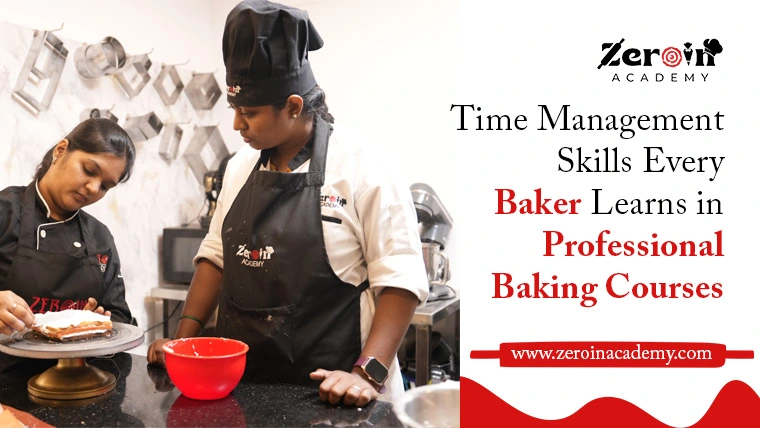
Perhaps the most underrated aspect of structured training is how much time it saves in the long run, even though it doesn’t always feel that way while it’s happening. A home baker might spend years learning, through trial and error, how long puff pastry actually needs to rest, or why a soufflé collapses when rushed. Professional courses compress that learning curve. Students don’t just receive recipes; they receive years of accumulated timing knowledge, tested and refined by people who baked before them. This is where structured environments like Zeroin Academy quietly earn their relevance, not by promising shortcuts, but by giving students a framework to understand time, rather than fight it.
Circling Back to That Sunday Evening
That 6 PM panic doesn’t disappear the moment someone finishes a course. But it changes shape. Instead of frustration, there’s understanding an awareness of why the cake needs to chill, why the dough needs its hour, why some things simply cannot be hurried. Time management in baking was never really about doing things faster. It was about learning to move at the pace the process demands, rather than the pace of impatience. For anyone looking for baking classes in Anna Nagar, this is usually the real takeaway, not a technique or a recipe, but a shift in how you relate to time itself. And it’s the kind of lesson that tends to stick around long after the actual recipes have been forgotten.
Why does baking feel more time-sensitive than cooking?
Because baking relies on precise chemistry rather than judgment. Once the batter goes into the oven, there is very little opportunity to make adjustments compared to cooking on the stovetop.
What is mise en place, and why does it matter for timing?
Mise en place means having all your ingredients measured, prepared, and within easy reach before you begin. It helps you stay organized and prevents costly delays during the baking process.
Can multitasking really be taught in a kitchen?
Yes. Managing multiple tasks, such as monitoring caramel while timing the oven, is a practical skill developed through consistent hands-on practice and experience.
Is patience something bakers are born with?
No. Patience is developed through experience because baking requires respecting processes like proofing, resting, and cooling, which cannot be rushed.
How do professional courses shorten the learning curve?
Professional training teaches proven techniques and the reasons behind them, helping students avoid common mistakes and learn in months what might otherwise take years.
Does better time management mean baking faster?
Not necessarily. Good time management means working efficiently while following the natural pace of baking, understanding that some steps cannot be rushed without affecting the final result.