There’s a moment every baker remembers. Standing at the oven window, watching a tray of pastry that simply refuses to rise the way it should. The butter has leaked out, the layers have fused into something dense and sad, and the question forms almost involuntarily: what went wrong, and why does this look nothing like what came out of the bakery down the street?
That moment is more common than most people admit, and it usually traces back to one root confusion. Puff pastry and croissant dough look related. Both rely on butter, both promise flaky layers, both fall under the broad umbrella of laminated dough. But they are built differently, they behave differently, and they serve entirely different purposes in a kitchen. This blog walks through what separates the two, starting with their core composition, moving into how yeast changes everything, examining the lamination process itself, looking at texture and rise, considering where each dough actually belongs on a menu, and finally touching on why structured environments like a Bakery Training In Chennai program tend to clear up confusion that recipes alone rarely do. By the end, the goal isn’t just knowing the difference on paper. It’s recognizing it in the hands, in the smell, in the way dough responds when it’s rolled out on a cool morning versus a humid afternoon.
The Core Ingredient List Isn’t as Similar as It Looks
Puff pastry is, at its simplest, flour, butter, water, and salt. No yeast, no leavening agent beyond steam. Croissant dough starts from a similar base but adds yeast and usually a touch of sugar and milk, turning it into an enriched dough. That single addition changes everything downstream. Puff pastry rises purely through mechanical means. Croissant dough rises through biology and mechanics working together. Once that distinction settles in, a lot of the confusion about texture and timing starts to make sense.
Yeast Changes the Entire Relationship With Time
A baker working with puff pastry can chill it, roll it, and bake it within a few hours, because there’s no fermentation clock running. Croissant dough doesn’t offer that flexibility. It needs proofing time, often an overnight rest, because the yeast has to do its slow work alongside the butter layers. Rushing this stage doesn’t just affect flavor. It affects whether the dough has the strength to hold its shape once it hits the oven. Patience here isn’t optional. It’s structural.
Lamination Looks the Same but Isn’t
Both doughs are laminated, meaning butter is folded into the dough in repeated layers. But the number of folds, the resting periods between them, and the temperature control required differ noticeably .Puff pastry usually gets folded more times, building up hundreds of thin layers in the process, all in pursuit of that big lift and crisp, shattery bite. Croissant dough uses fewer folds because the yeast is already doing structural work, and too many folds would compress the air pockets the fermentation creates. Anyone who has rushed this stage knows the frustration of butter melting into the dough instead of staying in distinct sheets. It’s one of the more humbling lessons in pastry work.
Texture Tells the Real Story
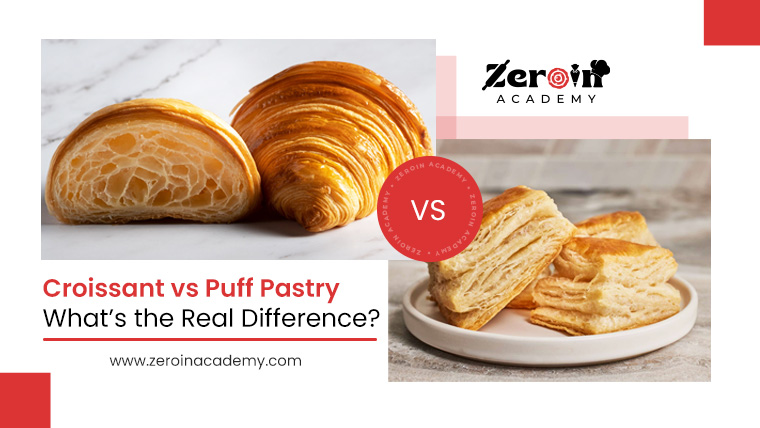
Bite into puff pastry and it shatters, almost glass-like, with a crispness that doesn’t compromise. Bite into a croissant and there’s a give to it, a slight chew beneath the flake, because the yeast has built an internal crumb structure that puff pastry simply doesn’t have. Neither is better. They’re built for different sensations entirely, and once a baker tastes both with that distinction in mind, the difference becomes obvious rather than subtle.
Where Each Dough Actually Belongs
This is where practical kitchen knowledge becomes valuable. Puff pastry suits vol-au-vents, tarts, and savory pockets where crispness and shape-holding matter. Croissant dough belongs to viennoiserie, the world of breakfast pastries where a soft, layered interior is the entire point. Mixing them up isn’t a small error. A croissant made with puff pastry technique loses its chew. A tart made with croissant dough turns chewy instead of crisp. Knowing which dough belongs where shapes the final product more than most people expect going in.
Why Structured Learning Changes the Equation
Recipes can describe ratios and folding counts, but they rarely explain why a dough feels too warm under the palm, or why one batch laminates cleanly while another tears. That kind of judgment usually evolves through repetition under guidance, not through reading alone. Many who eventually master both doughs point to time spent in a structured setting, where mistakes get corrected in real time and technique builds gradually rather than through trial and error alone.
Coming back to that oven window moment: the difference between a collapsed pastry and a properly laminated one was never about luck. It was always about understanding two doughs that look related but aren’t. For anyone in Chennai genuinely curious about closing that gap, exploring Baking Classes In Chennai Velachery offers a grounded next step, one rooted in practice rather than guesswork.
Why does my puff pastry turn out dense instead of flaky?
Usually this happens because the butter becomes too warm or the dough does not get enough resting time between folds. Proper chilling helps maintain clear layers and creates the flaky texture you expect.
Can puff pastry be substituted for croissant dough?
Not successfully. Croissant dough relies on yeast fermentation for its unique rise, texture, and flavor, while puff pastry depends only on lamination and does not have the same structure.
How many folds does croissant dough typically need?
Croissant dough generally requires three folds. This is fewer than puff pastry because croissants need to protect the air pockets created through fermentation and proofing.
Why does croissant dough need overnight proofing?
Slow fermentation during overnight proofing develops better flavor and strengthens the gluten structure, allowing the dough to handle the lamination process properly.
Does humidity affect lamination badly?
Yes. Warm and humid conditions can soften the butter quickly, causing the layers to merge together instead of staying separate. Proper temperature control is important for successful lamination.