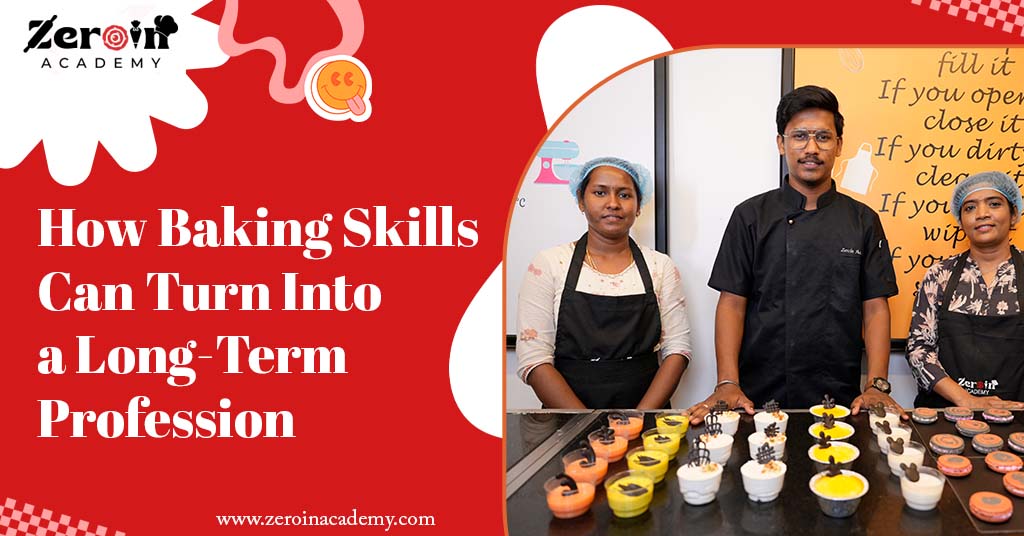
There’s a moment most bakers remember clearly. Not the glamorous one, not the perfectly plated dessert or the applause at a dinner party. It’s usually quieter than that. Maybe it’s 11 pm and you’re standing in your kitchen, watching a dough slowly come together under your hands, and something inside you thinks: I could do this every day. Not as a weekend thing. Not as a side hobby. Every single day, as a real living.
That thought is exciting and terrifying at the same time.
Most people push it aside quickly. The practical voice kicks in baking isn’t stable, it’s hard to make money from, people won’t take it seriously. And so the thought gets filed under “someday,” and someday rarely comes.
But here’s what we’ve seen working with students at Zeroin Academy: the doubt isn’t wrong to exist, but it’s almost always based on an incomplete picture. Before you step into Baking Classes in Chennai, it’s worth slowing down and honestly looking at what a baking career actually looks.
Career Progression of a Professional Baker
When most people imagine a baker’s career, they picture a straight line. Start at the bottom, work your way up, eventually run the place. That path exists. But the honest picture is more interesting than that.
A professional baker’s career doesn’t just climb, it deepens.
In the early years, you’re building a language. How dough behaves under different conditions, why fermentation works the way it does, how fat and water interact in pastry. These aren’t recipes you’re memorising, they’re principles you’re internalising. The moment you stop following instructions and start understanding what you’re doing, how kitchens see you completely changes.
From there, careers branch rather than simply ascend. Some bakers move toward artisan bread. Others find their calling in chocolate, sugar work, or Viennoiserie. Specialisation is where professional identity gets built. And over time, that identity opens doors senior roles, creative leadership, consulting, teaching, entrepreneurship. The progression isn’t always fast. But it compounds quietly and steadily.
Highest Paying Baking Jobs and Career Options
People are genuinely surprised by the range of well-paying opportunities within this field.
Executive pastry chefs at luxury properties earn salaries that hold their own against many corporate roles. Chocolate specialists and sugar artists working in high-end hospitality are actively sought after and there simply aren’t enough of them. Food stylists who understand baking deeply have built entire freelance careers at the crossroads of food and visual media. Recipe developers work with brands on a consultant basis. Culinary content creators have built real audiences and income streams that didn’t even exist ten years ago.
Then there’s the entrepreneurial side specialty patisseries, cloud kitchens, home bakery operations that have become genuine businesses for people who pair technical skill with commercial thinking. When people say “you can’t make money in baking,” they’re imagining a much narrower version of the industry than actually exists.
Future of Baking as a Profession
The industry is changing, and not in the way people fear.
There’s a growing appetite for quality for artisan products, for baked goods that carry craft and intention, for experiences that feel personal rather than mass-produced. Across Indian cities, specialty bakery cafes are genuinely thriving. Plant-based patisserie has moved from niche curiosity to real specialisation. Sourdough and fermentation have gone from fringe conversation to mainstream menus.
Internationally, demand for trained pastry professionals consistently outpaces supply. The future of baking as a profession isn’t contracting. It’s expanding into new shapes and the bakers who trained seriously are the ones finding themselves well-placed in that shift.
Is Baking a Transferable Skill for Other Careers
This question matters more than it gets credit for.
The qualities that baking builds in you, like patience, precision, the ability to troubleshoot under pressure, an instinct for sensory detail don’t stay locked inside a kitchen. They travel. Trained bakers move into food product development, quality assurance in food manufacturing, culinary education, food writing, and nutrition consulting. The technical grounding you carry as a pastry professional gives you something many people in adjacent fields simply don’t have.
Your skills evolve with you. They reshape themselves for new contexts. Years into your career, that foundation keeps giving back.
How Baking Skills Can Lead to Long-Term Career Growth
Longevity in this industry rarely comes down to talent. It doesn’t even come down to passion, though passion helps on the hard days.
What actually builds a long career is the depth of your foundation.
Bakers who trained comprehensively who didn’t just learn techniques but understood the principles behind them, find their careers stay flexible in ways others don’t. They adapt to new kitchens, new trends, new formats. They can teach, consult, and pivot without starting over. This is the thinking behind the International Diploma in Baking and Patisserie at Zeroin Academy. Not built to produce fast results. Built to produce deep ones, the kind that stay with you, grow with you, and eventually become something you can pass on.
Back to That Quiet Moment in the Kitchen
That thought you had I could do this every single day, it deserves a real answer. Not a motivational speech. A grounded, honest one. Yes, baking can become a long-term profession. But it becomes one when you approach it seriously from the beginning, when you choose depth over shortcuts and build understanding, not just technique.
If you’re in Chennai and this path feels real to you, our baking classes in Anna Nagar are designed for people at exactly this crossroads not hobbyists, but people genuinely asking whether this can become something lasting.
It can. It starts with how you choose to learn it.