Introduction
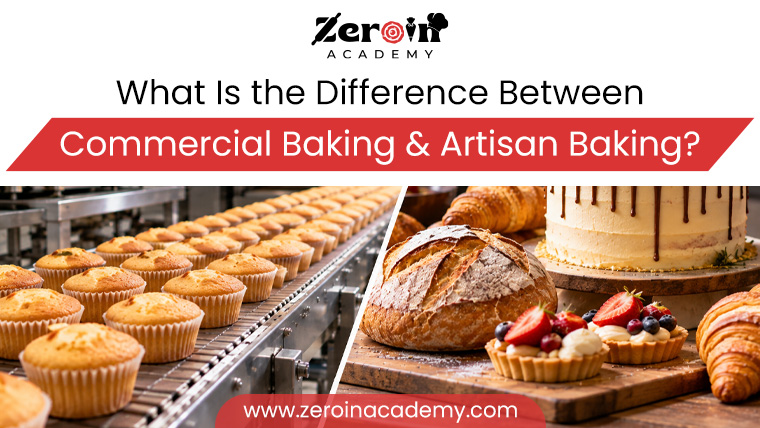
Commercial baking and artisan baking are different in scale, in the ingredients they use, in the fermentation time, the equipment, the consistency, the shelf life and the skills needed for each. Automated mixers, dough conditioners and tunnel ovens keep the cost per unit low and delivery schedules predictable as commercial bakeries churn out thousands of identical units a day. Small batch, hand-made from ingredients, long fermentation and each bake is adjusted according to dough temperature, humidity and how the flour behaves. Artisan products develop more flavor and a more varied crumb, while commercial products stay on the shelves longer. The career paths, startup costs and training requirements are also different. At Zeroin, we teach both methods, and our Bakery Classes In Chennai help you understand where each approach fits before you commit to a career or a business plan. The sections below explain each difference in detail.
How Commercial Baking Works
Commercial baking is built around repeatability. A production bakery sets a formula, programs the mixers, proofers, and ovens, and expects every loaf to match the last one within a narrow tolerance of weight, height, and color.
To reach that consistency, commercial formulas often include emulsifiers, enzymes, preservatives, and dough conditioners. These ingredients shorten mixing time, strengthen the dough against mechanical handling, and extend mold-free shelf life to five or seven days. Fermentation usually runs between one and two hours, accelerated by higher yeast levels and warm proofing chambers.
Staff in these facilities monitor temperature logs and follow written specifications.
How Artisan Baking Works
Artisan baking places the baker’s decisions at the center of production. A typical artisan loaf contains flour, water, salt, and either a sourdough culture or a small amount of yeast. Nothing else is required.
Fermentation runs from twelve to forty-eight hours, often with a cold retard in the refrigerator overnight. This slow process produces organic acids and aromatic compounds that a two-hour proof cannot generate. The baker shapes loaves by hand, scores them individually, and decides when to load the oven by checking dough strength with a finger test rather than a timer.
Steam-injected deck ovens produce the blistered, thick crust that customers associate with hand-made bread. No two batches are identical. Flour absorbs water differently from one season to the next, and a baker who cannot read those changes will produce dense, flat bread.
Commercial vs Artisan Baking: Key Differences
FactorCommercial BakingArtisan BakingBatch sizeThousands of units dailyDozens to a few hundredIngredientsFlour, yeast, conditioners, preservativesFlour, water, salt, starter or minimal yeastFermentation1 to 2 hours12 to 48 hoursShapingMachine divided and moldedHand shaped and scoredShelf life5 to 7 days1 to 2 daysConsistencyNear identicalVaries by batchEquipmentSpiral mixers, tunnel ovens, proofersDeck ovens, bannetons, bench toolsLabor skillMachine operation, quality controlDough reading, shaping, fermentation control
Ingredients and Additives
The ingredient list shows the clearest difference between the two methods. A commercial sandwich loaf may list fifteen or more components, while a sourdough boule lists four or fewer.
Additives in commercial baking serve specific functions. Ascorbic acid strengthens gluten, calcium propionate prevents mold, and monoglycerides keep the crumb soft for days.
Artisan bakers avoid these additives because their customers buy within hours of baking. Without preservatives, the loaf stales faster, so artisan shops bake daily and sell out or reduce production the next morning.
Fermentation, Flavor, and Texture
Time is the main variable. Short fermentation yields a uniform, soft crumb with mild flavor, which suits sandwiches, burger buns, and packaged bread. Long fermentation yields an open, irregular crumb, a thick crackling crust, and a flavor that includes tang, malt, and caramelized notes.
Long fermentation also affects digestibility. Extended proofing breaks down part of the phytic acid and some fermentable carbohydrates in flour, and many customers report that sourdough sits more comfortably than fast-proofed bread.
Cost, Equipment, and Business Models
A commercial plant requires significant capital. A mid-size line with a divider, rounder, moulder, proofer, and tunnel oven costs several crores and needs a distribution network to justify the investment. Margins per unit are thin, and profit depends on volume.
An artisan bakery can begin with a deck oven, a planetary or spiral mixer, a proofing cabinet, and a rented kitchen. The margin per unit is higher because you are charging more for hand crafted products, but you are limited in output by the number of hours your team can work.
Many successful operators in Chennai combine both models. They run a controlled production line for cakes, cookies, and buns, and they bake a small range of hand-shaped breads for premium customers.
Which Path Fits Your Goals
- Commercial track: Suits you if you want roles in production management, food safety, quality assurance, or large-scale supply to retailers and hotels.
- Artisan track: Suits you if you want to open a neighborhood bakery, sell at weekend markets, or work as a head baker in a specialty cafe.
- Hybrid track: Suits you if you plan to operate a home-based or cloud bakery that mixes scheduled bulk orders with premium items.
How Zeroin Teaches Both Methods
At Zeroin, we structure every course around hands-on practice. You mix, ferment, shape, and bake in each session, and our instructors correct technique at the bench instead of describing it from a slide.
Our curriculum covers baker’s percentages, dough temperature calculation, starter maintenance, lamination, and scaling recipes from 2 kilograms to 20. You also learn recipe costing, because new bakery owners often underprice products by ignoring labor and wastage.
Conclusion
Commercial baking delivers volume, consistency, and shelf life, while artisan baking delivers flavor, texture, and craft-based pricing. Both methods require technical knowledge, and the best bakers understand the reasons behind each choice. If you plan to build skills in either direction, our Baking Classes In Velachery at Zeroin give you supervised practice, current formulas, and guidance from instructors who work with both production and artisan methods. Visit Zeroin to select the course that matches your career plan.
Frequently Asked Questions
Is artisan bread healthier than commercial bread?
Artisan bread usually contains fewer additives and ferments longer, which many people find easier to digest. Nutritional value still depends on the flour used, so a whole wheat commercial loaf can compare well with a refined flour artisan loaf.
Why does artisan bread cost more?
Artisan bread requires longer fermentation, hand labor, and smaller batches. Each loaf occupies oven space and staff time that a commercial line would spread across hundreds of units.
Can a small bakery use commercial techniques?
Yes. Many small bakeries use dough conditioners, sheeters, and standard formulas for cakes, buns, and cookies to keep output consistent during peak demand.
How long does it take to learn artisan baking?
You can learn the core techniques in a few months of structured practice. Consistent results with sourdough usually require six months or more, because you must bake across different weather conditions to understand dough behavior.
Do you need a formal course to start a bakery?
A course is not legally required, but it reduces costly errors in formulation, oven management, and food safety. Our students leave with tested recipes and costing sheets they can use immediately.