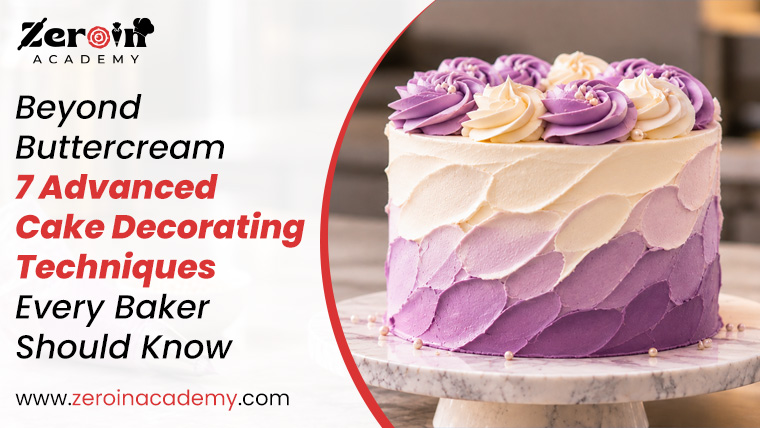
Buttercream handles everyday orders well, but wedding tiers, sculpted designs and entremets call for finishes that it cannot hold. Seven techniques separate a home baker from a professional decorator: sharp-edge ganache, fondant covering, mirror glaze, tempered chocolate work, gum paste flowers, airbrushing and royal icing piping. Each one depends on temperature control, correct consistency and a fixed order of steps, and each fails in a predictable way when one of those is missed. At Zero In Academy, we teach all seven through supervised practice, and students who join our Baking Classes In Velachery complete them before they decorate a client order. The sections below explain how each technique works, where it goes wrong and what you should practise first.
Why Buttercream Alone Falls Short in Professional Orders
Butter-based buttercream softens quickly, and kitchens and event halls in Chennai regularly run above 30°C. A tiered cake that travels to a hall in May can slump, sweat or lose its piped detail before the cake is cut. Clients who book wedding and anniversary cakes also expect straight sides and sharp corners, which buttercream rarely holds without a firm base underneath. Learning other surfaces and media gives you control over structure, finish and shelf life.
The 7 Advanced Cake Decorating Techniques
1. Sharp-Edge Ganache
Sharp-edge ganache gives a cake vertical sides and crisp corners, and it forms the base for fondant or a final coat of buttercream. A ratio of two parts dark chocolate to one part cream by weight sets firm enough to scrape smooth. You coat the cake, then press the top edge between a scraper and an acrylic plate until it forms a right angle. Warm ganache is the usual cause of failure, since it slides down the sides and leaves a rounded shoulder. Let it cool to a thick, spreadable consistency before you coat.
2. Fondant Covering With Clean Seams
Rolled fondant needs a firm base, so the cake should carry a ganache layer or a thin crumb coat chilled until hard. Roll the fondant to 3 to 4 mm, lift it over the cake with both forearms and smooth from the top downward, pushing air toward the edges. Corners need the most care because tension builds there and tears appear first. Cracked, wrinkled surfaces usually mean the fondant dried while you worked, so keep unused portions sealed in plastic and rub a little vegetable shortening on your hands instead of dusting with cornflour.
3. Mirror Glaze
Mirror glaze is a gelatin-based coating poured over a mousse cake or entremets that has been frozen solid. Temperature decides the result. A pour at 32 to 35°C coats the cake in one even layer, while a hotter pour thins out and runs off and a cooler pour leaves ridges. Blend the glaze with an immersion blender held below the surface and strain it, because trapped air shows up as pinholes in the finished shine.
4. Tempered Chocolate Decorations
Tempering stabilises the cocoa butter so that chocolate sets with a clean snap and a glossy surface. For dark chocolate, melt to 45 to 50°C, cool to 27 to 28°C, then rewarm to 31 to 32°C. Dull streaks or a soft texture on the finished piece mean the chocolate went out of temper. Properly tempered chocolate becomes curls, plaques, shards and wraps that keep their shape throughout an event, provided you work in an air-conditioned room.
5. Gum Paste Flowers
Gum paste dries hard and rolls thin enough to give petals natural, delicate edges. A single rose needs a cone base, supported petals and about 24 hours of drying before assembly. Because the flowers keep for weeks in a dry box with silica gel, you can prepare them well ahead of a wedding delivery date. Our Baking Classes In Velachery include repeated gum paste practice, since petal thickness and drying time improve only through measured repetition.
6. Airbrushing
Airbrushing lays food colour down in fine layers, which produces gradients, shadows and metallic finishes that a brush cannot. Set the compressor between 15 and 20 PSI, hold the airbrush 10 to 15 cm from the surface and build colour through several light passes, since one heavy pass pools and runs. The surface must be completely dry before you begin, or the colour bleeds at the edges.
7. Royal Icing Piping and Lace
Royal icing sets hard, which makes it the right medium for lettering, run-out collars, lace and extension work. Consistency can be measured: stiff icing holds outlines, while flooding icing should smooth over within about 15 seconds when you draw a knife through it. Pipe lace onto parchment, dry it completely and attach it with a dot of icing. Meringue powder gives a stable, food-safe base that behaves the same from batch to batch.
Matching Techniques to Client Orders
Experienced decorators choose the technique before they bake.
- Wedding tiers: sharp-edge ganache, fondant covering and gum paste flowers.
- Entremets and mousse cakes: mirror glaze over a frozen core.
- Tall celebration cakes: tempered chocolate wraps and shards for height.
- Personalised cakes: airbrushed backgrounds with royal icing lettering.
How We Sequence Decoration Training at Zero In Academy
Structure comes before ornament in our programme. Students learn ganache coating and fondant covering first, because flowers, airbrushing and piping all depend on a smooth, stable surface. We assess edge sharpness, surface finish, proportion and working time in every practical session and return feedback on which skill to repeat.
Build a Professional Decorating Skill Set With Zero In Academy
Advanced decoration rewards bakers who treat each technique as a measurable process, with set temperatures, thicknesses and drying times. If you plan to work in a bakery, run a home business or open your own studio, a Diploma in Baking Chennai from Zero In Academy gives you the structured training to apply all seven techniques on real orders. Visit our academy, review the course content and begin building the skills clients pay for.
Frequently Asked Questions
Which advanced technique should a beginner learn first?
Sharp-edge ganache. It teaches you to level a cake, control chocolate consistency and finish a clean surface, which every other technique builds on.
Can I cover a buttercream cake with fondant?
Yes, provided the buttercream is chilled until firm and the crumb coat is smooth. Fondant placed on soft buttercream shows every bulge, and refrigerator condensation leaves damp patches unless the cake warms slowly before covering.
How far in advance can gum paste flowers be made?
You can make them several weeks ahead. Store them in a dry, airtight box with silica gel, away from sunlight and humidity.
What equipment is essential for advanced decorating?
A digital thermometer, acrylic plates, a turntable, an offset spatula, a rolling pin with thickness guides, an airbrush with a compressor and a set of piping tips cover all seven techniques.
Why does my mirror glaze have bubbles?
Air enters the glaze when you blend it with the blade above the surface or stir vigorously. Keep the blender head submerged, strain the glaze and let it rest briefly before pouring.
How long does it take to decorate at a professional standard?
Most students need several months of regular, supervised practice before their results are consistent across different cakes.