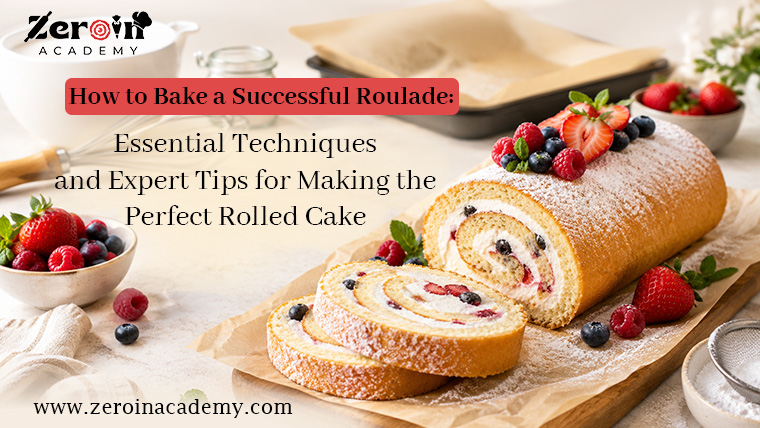
A successful roulade depends on six controlled steps: choosing the right sponge, preparing the tray accurately, whisking the eggs to full volume, baking briefly at a high temperature, rolling the sponge while it is still warm, and filling it only after it has cooled completely. Each step affects the flexibility of the sponge, and flexibility decides whether the cake rolls cleanly or splits across the surface. Cracks, a dense crumb and leaking filling almost always trace back to overbaking, deflated batter or a filling that is too soft for the room temperature. At Zero In Academy, we teach these stages in supervised practical sessions, and learners at our Baking Institute In Chennai repeat each step until the roll holds its shape without support. The sections below explain every stage in detail, beginning with the sponge itself.
Choose the Right Sponge for a Roulade
Three sponge types suit rolled cakes.
- Whisked sponge: Whole eggs and sugar are whipped to full volume, and flour is folded in with little or no fat. It rolls well and gives a light crumb, but it dries quickly when overbaked.
- Oil-based sponge: Egg yolks, oil and flour form the base, and whipped egg whites are folded in afterwards. It stays flexible for longer, which helps in warm kitchens where cakes lose moisture fast.
- Flourless chocolate sponge: Cocoa, egg yolks and whipped whites replace the flour. It cracks lightly during rolling, and a layer of whipped cream with a dusting of cocoa covers the surface.
For a first roulade, we recommend the whisked sponge, since it exposes errors in whisking and baking that an oil-based batter would hide.
Prepare the Tray, Ingredients and Oven
A 30 x 40 cm tray suits a batter made with four eggs. A larger tray spreads the batter too thinly, and the sponge dries out in the oven. Line the tray with parchment paper and grease the paper lightly so the sponge releases without tearing.
Ingredient choices affect the roll as much as the method does.
- Eggs at room temperature whip to a larger volume than cold eggs.
- Cake flour, sifted twice, folds in without developing gluten that would stiffen the sponge.
- Fine caster sugar dissolves completely during whisking and prevents a speckled crust.
Preheat the oven to 200°C (180°C for a fan oven) and place the rack in the centre position.
Whisk, Fold and Bake the Sponge
Whisk to the Ribbon Stage
Whisk the eggs and sugar on high speed for eight to ten minutes until the mixture triples in volume. When you lift the whisk, the batter should fall in a thick band that stays visible on the surface for about three seconds. This is the ribbon stage, and a batter whisked for only five minutes produces a dense sponge that cracks during rolling.
Fold the Flour in Three Additions
Sift the flour over the batter in three additions. Cut down through the centre with a spatula, sweep along the side of the bowl and lift, stopping once no dry flour remains. Extra folding releases the air built during whisking, and the sponge bakes thin and tough.
Spread and Bake
Spread the batter into the corners with an offset spatula and tap the tray once on the counter. Bake for 8 to 10 minutes. The sponge is ready when the surface springs back under a light touch and the edges begin to pull away from the paper. Two extra minutes in the oven make it brittle.
Roll, Cool and Fill the Roulade
Most roulades fail at the rolling stage. Turn the sponge out onto a sheet of parchment dusted with caster sugar within two minutes of leaving the oven. Peel off the lining paper, trim the crisp edges with a sharp knife and roll the sponge from the short side together with the sugared parchment. Leave it rolled for 20 to 30 minutes until it reaches room temperature, so the sponge sets in the rolled shape.
Unroll it gently and spread the filling in an even layer of about 5 mm, leaving a 2 cm border along the far edge. Make the first turn tight and firm, then continue with steady pressure. Place the roulade seam-side down, wrap it in parchment and refrigerate it for at least one hour. A long knife dipped in hot water and wiped dry between cuts gives clean slices.
Select Fillings That Hold in Chennai’s Climate
Heat and humidity soften fillings quickly in Chennai, so stability matters as much as flavour. Plain whipped cream loses its structure within an hour at room temperature.
- Stabilised whipped cream: Whip cream with mascarpone, or with a small amount of dissolved gelatin, to hold its shape for several hours.
- Chocolate ganache: Cool the ganache until it reaches a spreadable consistency, then whip it lightly for a fuller texture.
- Fruit curd with whipped cream: Mango or passion fruit curd folded into stabilised cream adds acidity that balances a sweet sponge.
- Buttercream: It stays stable at room temperature for longer, and a thin layer keeps the slice light.
When the room temperature exceeds 30°C, serve the roulade within 30 minutes of taking it out of the refrigerator.
Fix Common Roulade Problems
- Cracked surface: The sponge was overbaked, rolled after it cooled or spread too thickly. Reduce the baking time by one minute and roll while the sponge is warm.
- Dense crumb: The eggs were under-whisked or the flour was over-folded. Extend the whisking time until the ribbon stage holds for three seconds.
- Sticky top: Cling film applied while the sponge was warm trapped steam. Use parchment or a clean dry cloth for the first roll.
- Leaking filling: The filling was too soft or spread too thickly. Chill the filling for 20 minutes before spreading, and keep the layer at about 5 mm.
- Uneven spiral: The first turn was loose. Press the first fold firmly against the filling before rolling further.
Learn Roulade Techniques at ZeroIn Academy
At Zero In Academy, we teach roulade as part of our cake and patisserie training. Students whisk, bake, roll and fill their own sponges, and our trainers check the ribbon stage, baking colour and rolling pressure at each step so that errors are corrected during the session and not after the cake has set. Learners who want to build these skills with trainer feedback can begin with Baking Classes in Anna Nagar at Zero In Academy, where the course covers sponge methods, fillings and finishing.
What is a roulade?
A roulade is a thin sponge cake that is spread with a filling and rolled into a spiral. Swiss rolls and Yule logs both follow this format.
Why does my roulade crack when I roll it?
Cracking usually results from overbaking or from rolling the sponge after it has cooled. A sponge baked for two minutes too long loses moisture and cannot bend, so check it at eight minutes and roll it within two minutes of leaving the oven.
What temperature and time work best for a roulade sponge?
A thin whisked sponge bakes in 8 to 10 minutes at 200°C, or at 180°C in a fan oven.
How thick should the sponge be?
A thickness of about 1 cm gives a sponge that bends without breaking. Thicker layers need longer baking, which dries the edges before the centre sets.
Can I make a roulade in advance?
You can bake and roll the sponge a day ahead and wrap it tightly in parchment. A filled roulade keeps for up to two days in the refrigerator, although the sponge softens as it absorbs moisture from the cream.
Which filling works best in hot weather?
Stabilised whipped cream made with mascarpone and chocolate ganache both hold their shape better than plain cream, so keep the assembled roulade chilled until shortly before serving.